

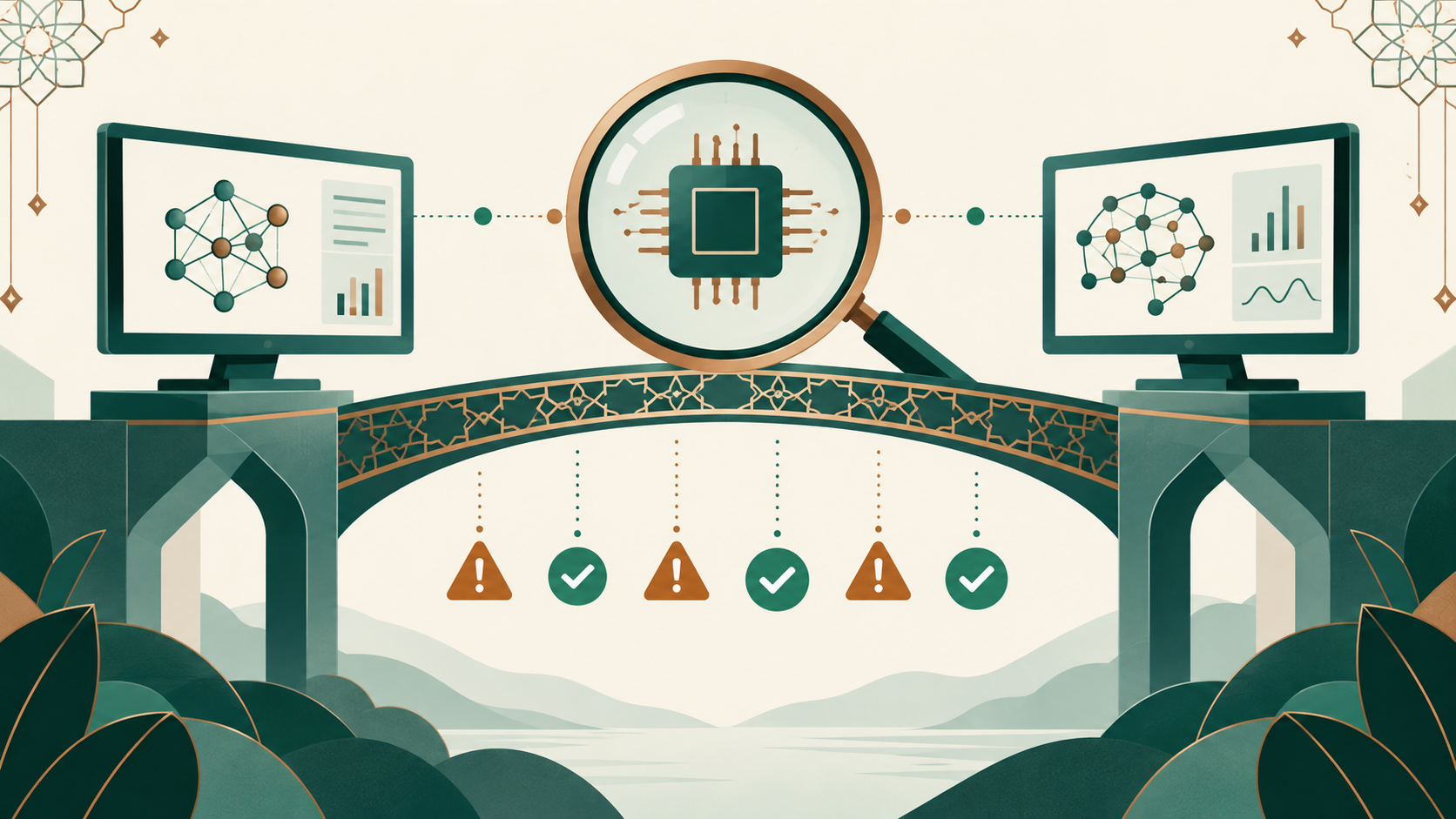
On 13 October 2026, the UK and Canadian governments announced a renewed partnership on artificial intelligence security. They plan compatible standards and exchanges on risks and testing methods for powerful models. The UK and Canadian AI safety institutes are exploring staff exchanges and coordinated testing. See the UK government's official announcement.
The announcement sets out plans. Users need product-specific details: what was tested, what failed, and how it was fixed.
Why it matters
Imagine a learning centre that uses AI to prepare assignments. Even after a successful demo, ask whether the assistant invents sources, who checks the materials, and how wrong answers are corrected.
Joint testing brings different perspectives. Tests should reflect actual use. If the centre works in Tatar, a few successful answers in English are insufficient.
Assessment under the Code
The Islamic Code for the Use of AI requires checking the reliability of information (2.1.8) and monitoring systems continuously (2.2.17). When a model is updated, it should be tested again. Earlier results do not automatically carry over to the new version.
Section 3.2.1 calls for testing before deployment, including a religious and ethical audit. In our example, a qualified specialist should assess explanations of Quranic verses and rules of fiqh. Solving maths problems says nothing about the reliability of a religious answer.
The table assesses individual approaches. Sharia compliance for the partnership as a whole is outside this assessment.
| Approach | Code section | Assessment |
|---|---|---|
| Sharing testing methods | 3.2.1 | In line with the testing requirement. The coverage of the tests matters |
| Regular assessment of new risks | 2.2.17 | Supports ongoing monitoring when identified problems are fixed |
| Disclosing model limitations | 2.3.6 | Required by the Code. Compliance needs to be checked separately |
| Assigning responsibility and enabling shutdown | 2.2.9; 3.3.3 | Both are needed in the product. The announcement does not establish that they are in place |
What to do in practice
A school, foundation or small business can write down five things: the AI's task, unacceptable errors, the reviewer's name, where to report a problem, and how to stop the system.
For example, the assistant drafts a notice. A staff member checks the facts before publishing it. If a serious error is found, the team suspends use and works without AI for a time. This is our recommendation for applying the Code. It does not describe steps the partners have already taken.
The chief risk is stopping at a test report. Recording an error helps only if someone is responsible for reviewing and fixing it. Section 3.3.3 also calls for a clear way to revert to an earlier version after serious failures.
Open questions
The Code sets principles. It does not prescribe a universal test suite or an acceptable number of errors. Set those for the specific task with technical and subject specialists.
A suggested test template covers the system's purpose, test conditions, limitations, the person responsible and how to stop it. This is a proposal for guidance, not an adopted section of the Code.
Watch for published methods, test results and joint standards. They will help assess progress.
This article offers information and analysis. It is not a fatwa. Consult qualified scholars for religious rulings.
Ask a question or leave a comment on this article
Your pseudonym and comment will appear publicly as soon as you submit. Do not include your real name, contact details or other personal information.
Comment and request rules
Contact us about your comment